

It has now been 40 days since six staff members of the Women and Children Legal Research Foundation (WCLRF) were arbitrarily detained by Taliban authorities in Kabul. No charges have been brought against them, they have had no access to legal counsel, and their families have received little information about their whereabouts or well-being.
Despite calls for their release from UN Special Rapporteur Richard Bennett, Amnesty International, Human Rights Watch, and other human rights organizations, Sultan Ali Rahimi, Ahmad Sayem Hazim, Hamed Ahmad Sediqi, Abdul Matin Hakimi, Abdul Qadir Hamidi, and Bismillah remain in detention. Their families continue to live with fear and uncertainty about their safety and when they will see them again.
WCLRF is an Afghan civil society organization registered in Afghanistan since 2002. For more than two decades, it has conducted research and advocacy on how laws, policies, and social conditions affect the rights and well-being of women and children. This work should not be treated as a threat.
These detentions are part of a much wider assault on independent civil society and particularly on those defending the rights of women and girls. Since returning to power in August 2021, the Taliban have systematically restricted women’s education, employment, freedom of movement, and participation in public life. Girls are excluded from secondary education and women from universities. Increasingly, even documenting these realities, conducting independent research, or supporting women and children appears to be treated as opposition—and as a threat to Taliban rule.
The Taliban justify many of these policies through their interpretation of Islam and Afghan culture. Yet no other Muslim-majority country has imposed such sweeping prohibitions on women’s education and participation in public life. Nor can “culture” justify repression. When a government must enforce its version of culture through bans, intimidation, detention, and imprisonment, we must ask whether what is being defended is culture at all—or political power exercised in the name of culture.
We are equally concerned about the response of the international community. Five years after the Taliban’s return to power, engagement with Afghanistan is increasingly shaped by security, humanitarian, migration, and geopolitical concerns. These issues matter, but they cannot take precedence over the fundamental rights of Afghan people, particularly women and girls, or come at the cost of abandoning Afghanistan’s shrinking civil society.
Engagement without meaningful pressure has consequences. When arbitrary detention, the exclusion of women from public life, and the silencing of independent organizations carry few political consequences, repression becomes easier to extend.
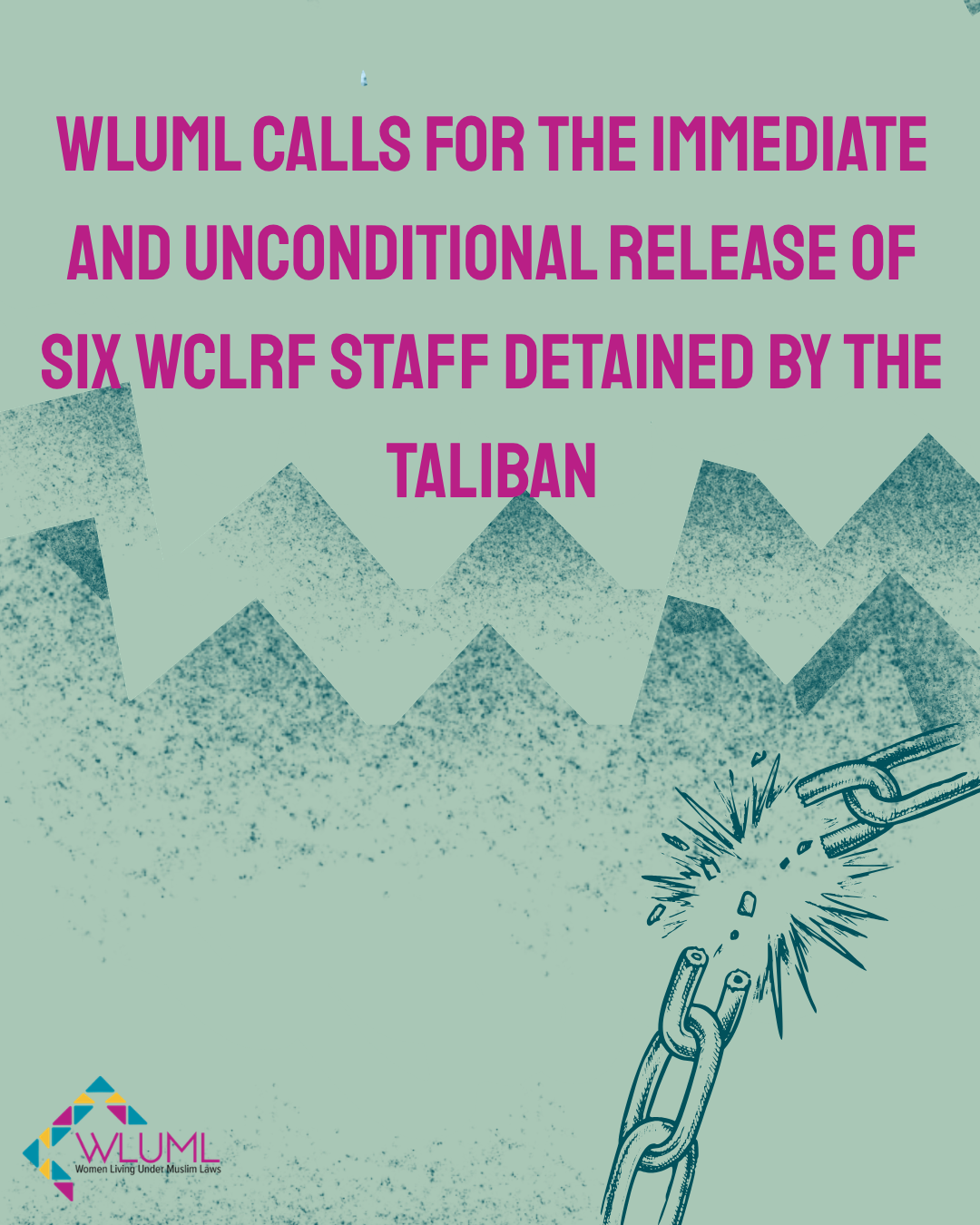
Women Living Under Muslim Laws (WLUML): Transnational Solidarity Network calls for the immediate and unconditional release of all six WCLRF staff members. Until they are released, Taliban authorities must disclose their whereabouts, guarantee their safety and well-being, and provide immediate access to their families and independent legal counsel.
We call on governments, UN bodies, and the wider international community to use their political and diplomatic influence to secure their release and challenge the Taliban’s escalating repression of civil society and human rights defenders.
The international community must not allow arbitrary detention, enforced disappearance, and the systematic silencing of those defending women and children to become an acceptable cost of engagement with the Taliban.
These six human rights workers must not be forgotten. Release them immediately and unconditionally.
Women Living Under Muslim Laws